How to Pick the Right Rug Size for Your Living Room
Master living room rug placement with exact dimensions, furniture layouts, and sizing rules that stop your space from looking cramped.
In this article
- Key Takeaways
- What are the three classic rug placement layouts?
- Which standard rug size fits your room dimensions?
- How much space should you leave between the rug and the wall?
- How do you arrange a rug with a sectional sofa?
- What are the most common rug placement mistakes?
- How do you test the size before buying?
The core rule of living room rug placement is simple: anchor your seating by placing at least the front legs of all major pieces on the rug, while leaving 10 to 18 inches of bare floor between the rug edge and the walls. A rug that floats isolated beneath a coffee table without touching your sofa shrinks the visual footprint of the entire room.
Key Takeaways
- The Golden Margin: Leave 10 to 18 inches of exposed flooring between the rug edge and the room perimeter to maintain balanced proportions.
- Front Legs On: The most versatile arrangement places the front two legs of sofas and accent chairs on the rug, running 6 to 8 inches past the furniture on either side.
- Avoid the Island: Never place a tiny rug under just the coffee table; if furniture cannot touch it, the rug is too small.
- Standard Sizing Rules: Most living rooms require an 8x10 foot or 9x12 foot rug; a 5x7 foot rug is generally reserved for compact studio apartments.
What are the three classic rug placement layouts?
Every living room layout uses one of three foundational frameworks: all legs on the rug, front legs only, or all legs off.
1. All Legs on the Rug
This layout requires a massive rug, typically 9x12 feet, 10x14 feet, or larger. The sofa, side tables, accent chairs, and coffee table sit entirely on the rug surface with several inches to spare behind them.
This setup works best in expansive, open-concept floor plans where you need to define a separate conversation zone without building physical walls. The trade-off is maintenance and cost. Giant rugs are expensive, heavy to clean, and make running lamp cords underneath tricky unless you have floor outlets.
2. Front Legs Only (The Universal Standard)
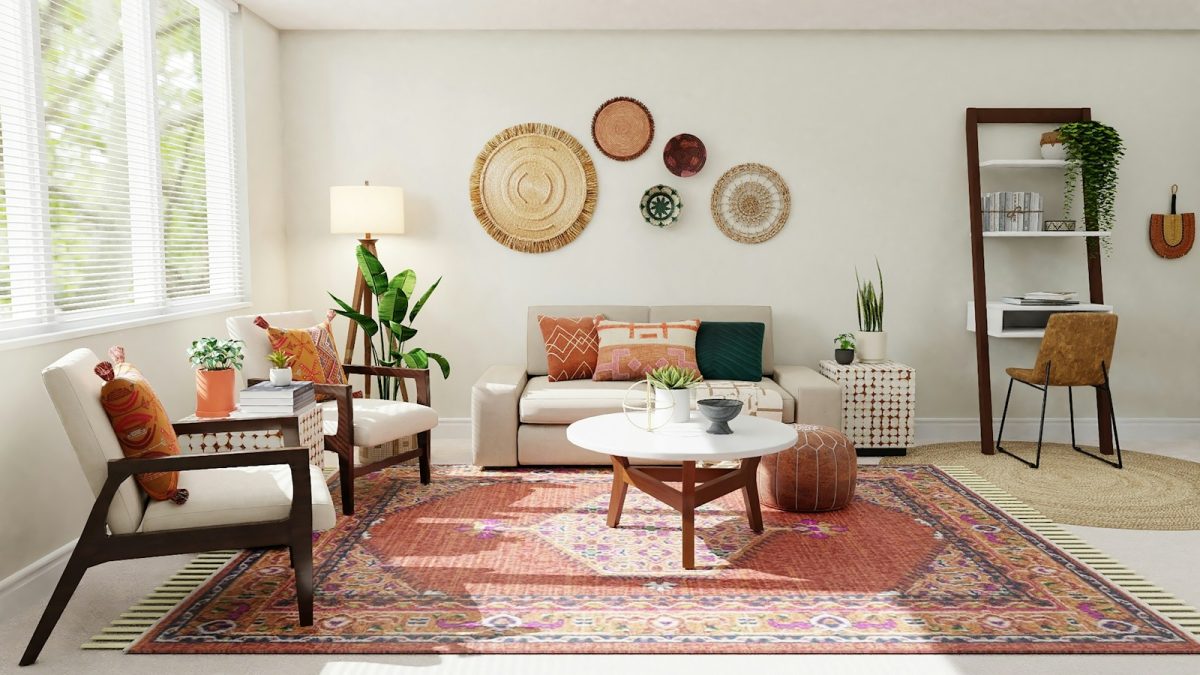
This is the most reliable approach for standard living rooms. The front legs of your couch and accent chairs rest firmly on the rug, while the back legs remain on the bare floor.
Aim to pull the rug roughly one-third to halfway under the main seating. This ties every piece together into a cohesive grouping without forcing you to buy an oversized 10x14 textile. It also hides awkward cord runs easily beneath the front perimeter.
3. All Legs Off (Except the Coffee Table)
In this layout, only the coffee table rests on the rug. The sofa and accent chairs sit completely on the bare floor, with the rug pulled right up to the edge of the seating.
Use this approach only if your room is genuinely small or awkwardly configured around floor vents and doorways. The margin between the edge of the rug and the edge of the sofa should be tight, no more than 1 to 2 inches. If the gap is larger, the rug ends up looking like a bath mat that wandered into the living room.
Which standard rug size fits your room dimensions?
Standard manufactured rugs come in predictable dimensions: 5x7 or 5x8 feet, 8x10 feet, 9x12 feet, and occasionally 10x14 feet. Choosing between them comes down to room dimensions and furniture footprint.
| Rug Size (Feet) | Best Room Size | Recommended Layout Type | Typical Furniture Accommodated |
|---|---|---|---|
| 5 x 8 | Under 10 x 12 ft | All legs off, or front legs of small sofa | Loveseat, compact coffee table |
| 8 x 10 | 10 x 13 ft to 12 x 15 ft | Front legs on | 84-inch sofa, 2 chairs, coffee table |
| 9 x 12 | 12 x 16 ft to 14 x 18 ft | All legs on or front legs on large pieces | Large sectional, accent chairs, end tables |
| 10 x 14 | 15 x 20 ft and up | All legs on | Full seating suites, massive sectionals |
A standard 84-inch sofa paired with two armchairs almost always demands an 8x10 foot rug. Slipping a 5x7 foot rug under an 84-inch sofa creates an inverted pyramid effect, pulling the viewer's eye inward and making the seating area look top-heavy.
How much space should you leave between the rug and the wall?
The baseline distance between a living room rug and the surrounding walls is 10 to 18 inches.
In a compact living room measuring around 11x13 feet, shrink that margin down to 8 or 10 inches so you can squeeze in the largest rug possible without curling up against the baseboards. In a spacious 16x20 foot living room, an 18 to 24-inch border of exposed hardwood creates an intentional framing border around the room.
Always measure to the baseboards, not the drywall. If your room features unusual architectural quirks like a fireplace hearth, keep the rug at least 6 to 12 inches away from the hearth edge to prevent fire risks and visual clutter.
How do you arrange a rug with a sectional sofa?
Sectionals follow the front-legs-only rule, but with a strict requirement for coverage across both directions.
Every section of the couch must connect with the rug. If the main chaise sits on the rug but the opposite return rests completely on bare hardwood, the entire room reads as lopsided.
To pull this off:
- Choose an 8x10 or 9x12 foot rug oriented in the same direction as the longest side of your sectional.
- Extend the rug at least 6 to 8 inches past both ends of the sofa wings.
- Tuck the rug under the front edge of the entire sectional by roughly 6 to 12 inches.
If your sectional has an extended chaise lounge, make sure the chaise does not hang over the rug into empty space. The full length of the chaise extension should sit on top of the rug fibers.
What are the most common rug placement mistakes?
Most decorating mistakes with living room rugs stem from treating the rug as a decorative picture frame rather than an architectural anchor.
- Buying for the coffee table instead of the room: A coffee table rarely exceeds 4 feet in length. Buying a 4x6 foot rug anchors the table, but completely abandons the seating around it.
- Ignoring walkway flow: A rug that ends midway through a high-traffic walking path creates a tripping hazard and wears unevenly. Either extend the rug so people walk fully on it, or end it short enough that walkways remain entirely on bare floor.
- Skipping the rug pad: A thin, sliding rug looks messy and degrades quickly. Use a dense felt-and-rubber pad trimmed exactly one inch shorter than the rug on all sides. This holds the rug in position and protects your flooring from backing friction.
- Centering to the room instead of the seating: If your seating area is shifted toward one wall to accommodate a media console or doorway, center your rug under the furniture grouping, not in the dead geometric center of the room.
How do you test the size before buying?
Before ordering a rug, test the scale in real life using blue painter's tape directly on your floor.
Map out the exact exterior dimensions of the rug you are considering: 8x10, 9x12, or custom dimensions. Leave the tape down for a full afternoon while moving through the house. Sit on your sofa, walk into the kitchen, open nearby cabinet doors, and observe where the border sits. If the taped boundary breaks up normal foot traffic or sits two inches short of your armchair's front feet, step up to the next standard size before spending any money.